![]() |
The
Paramount ME
(Updated on 05/18/2008) |
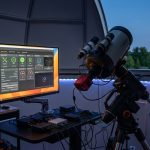
For info about the Paramount ME upgrade click the image above.
These images are of the telescope,
showing various configurations that the scope is used in, as well as some of
it's accessories. The main scope is a Meade 10" LX200GPS. It stock
configuration is a 2500mm focal length at F10. The above photo shows the scope
configured for AZ/ALT mode and tripod mounted. The scope piggy-backed on top is the optical tube assembly
that was cannibalized from
a ETX90EC. The pink and yellow stickers on the bottom rail mark the
location the weight should be moved to when accessories are added or removed.


This photo shows the Pictor 201 autoguider
connected to the ETX90 OTA which is piggy-backed on the LX200GPS. I never
had any luck making the 201 work correctly (even after spending countless hours
when it was connected to the LX200GPS via the off-axis guider). The 201 is not a
user friendly device. In fact I now believe that Satan himself may have designed
it.
•Here the Meade 10" LX200GPS sits polar mounted in the observatory on the
polished aluminum Milburn wedge (which is currently covered with finger prints).
•The
Meade ETX90EC guider scope can be seen hanging down (which is really the top
side of the scope). Also visible are the cables for the dew heaters.
•The
cables are covered with Flexi-Tube. This prevents the cables from becoming
tangled during scope movement.
This is the same kid I see at my diner table every night. In this picture the
telescope is configured for sunspot observing. You can see the
mirrored white light glass solar filter perched on the front. While this filter produces
natural color views of the sun, no prominences or surface details other than sunspots are
visible. (Note the finder and guide scope
remained covered to protect them from the sun).


These still pictures are screen captures from the 2 night vision video
monitoring cameras inside the observatory during night time remote operations.
These cameras are used to monitor the telescope in case of cable wrap or
"runaway slews". This
SLEW MOVIE
(approx 6.5 megs)
shows the telescope and dome rotation from an
outside security camera as well as one of the indoor monitoring cameras.

Here the 3 piggy backed scopes can be seen on top.
From left to right they are:
* Short Tube 80, 400mm F7
wide field scope. In this picture the ST80 is configured for solar viewing.
Solar filter material has been installed in the small
center aperture. During solar viewing, only the small dust cap is removed.
For night time viewing the larger cap is removed. The small scope on the
extension is the finder
scope from the ST80.
* Coronado ScopeMax 40 (brass). It's a 40mm solar only telescope
with a 400mm focal length. The front of
the scope has a energy rejection filter (ERF) to cut the harmful heat and UV
energy from the sun, The black section behind the energy rejection filter is the
Hydrogen-Alpha filter. This filter is tunable in order to allow views of the sun's surface as well as
prominences.
* 8X50mm finder scope for the 10" LX200GPS.
•If
you look closely underneath the LX200GPS you can see the ETX90. It was moved from the top to the bottom when the ScopeMax and ST80
were added.
•The
top side scopes are attached using rails mounted on the two outer most
mount locations. A bracket was fabricated using parts from the local Home Depot
to hold the solar scope. In this configuration the scope weights almost 93
lbs.
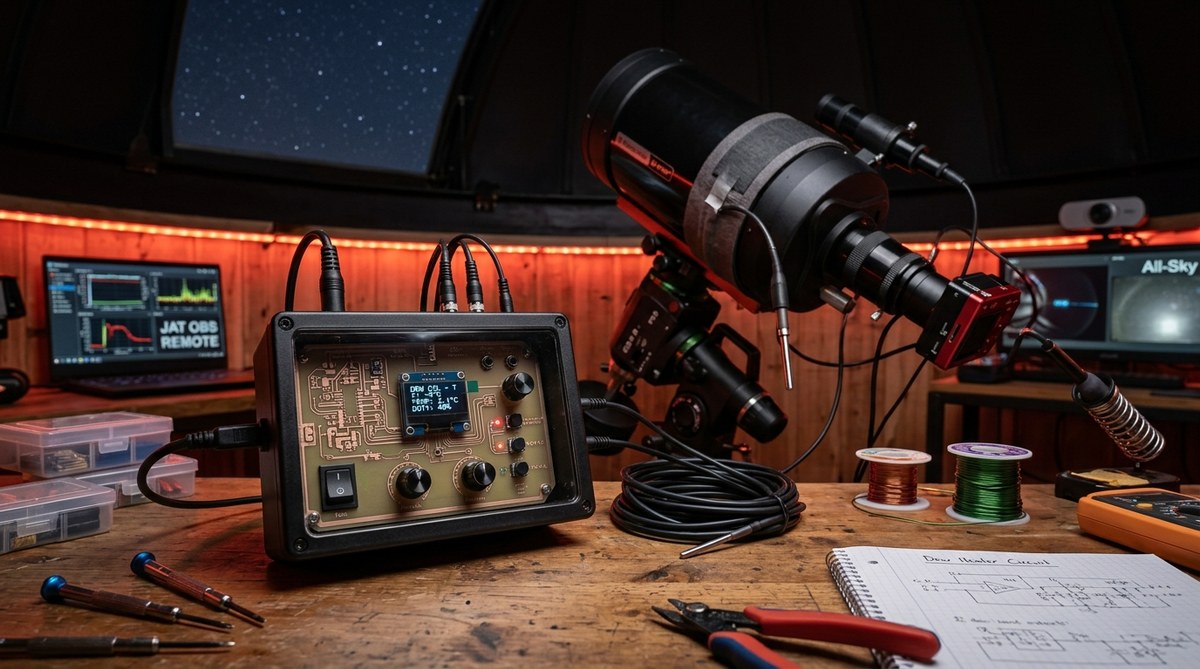
•The the black raised strip of fabric is the
dew heater for the main scope. It can be seen just covering the "M" in Meade.
The heater keeps the corrector plate warm so dew will not form on it. The heater
strip is controlled by a heater controller mounted on the right fork arm (not
visible in the above photo). The controller uses a thermocouple located on the
bottom on the aluminum dew shield to measures the ambient air. It then maintains
the temp of the heat strip up to 20 degrees warmer than the ambient air. The
delta temp is set by a thermostat on the controller.

•Another view of the top mounted piggy-backed scopes. In
this view you can see the dew heaters mounted on the Short Tube 80 and the 8x50
finder scope. The heater strip on the ST80 is thermostatically controlled.
The one on the finder scope is not.
•The Coronado Maxscope40 (center) has no dew heaters.
•The "N" on the wall indicates the direction of true north. The colored marks are
used to accurately align the dome within 1 degree before the beginning of an
observing session.

In this configuration the ETX90 is shown mounted to bottom of the
LX200GPS. Notice the ETX90 has been rotated 90 degrees clockwise. This allows the flip
mirror on the ETX90 to also be used when it mounted under the LX200. The ETX's finder scope was removed because it was to close to the rear mounting
ring's adjustment screw. That location also didn't allow a cover to be
placed on it during a solar viewing session. Without the cover the finder scope
would be damaged when pointed at the sun. A stabilizer bar was installed between
the 2 mounting rings to keep the ETX90 from vibrating when the main telescope is slewed.

The ETX90 with the Meade LPI (Lunar Planetary Imager) attached to the visual
back. The USB cable connects to a 4 port hub mounted on the side of the
adjustable height pier. In this configuration the ETX90 can be used as either a
computer controlled autoguider for
the main scope or as a lunar or bright planet imaging scope.

The business end of the scope showing another solar viewing
configuration. The 77mm energy rejection filter seen attached to an aluminum
cover on the main scope is from
Lumicon. This setup uses a Hydrogen-Alpha 1.5 Angstrom filter which is mounted
just ahead of the eyepiece. This filter is also adjustable and allows viewing of prominences and sunspots, but little or no surface
detail.

•The front of the ETX90 (with dust cap on) is visible in
this shot hanging from the bottom of the LX200GPS.
•The DewBuster heater controller can be see mounted on the right
fork arm. The heater controller's thermocouple is visible as a dark horizontal line
just below and to the left of the white square at the bottom of the large cover.

•Back end of the "belly-mounted" ETX90 with the
Meade LPI attached. The EZ-focus knob (white circle with numbers) can be seen at upper right
on the LX200GPS. This knob was added to
help with fine manual focus adjustments.
•The Autostar-II hand box sits in the
holder (an option for the Milburn wedge). The holder has had a heater pad
attached to the bottom
to keep the controller warm during cold observing sessions. The heater is
controlled by the DewBuster, but is not on a thermostat. The handbox holder was
insulated from the 1 inch thick aluminum wedge, so heat would not transfer to
the wedge instead of warming the controller.
•Close examination of the base of the
telescope will
reveal labeling on each of the cables and their corresponding connection
location. This aids with the cable reconnections when the scope has been removed from the
mount for maintenance or service.

The Pictor 416XT CCD camera (sans color-wheel) is shown here
mounted to the visual back of the ETX90 OTA. A 90 degree diagonal was used
to mate the camera to the ETX. Care must be taken when the scope is in this configuration,
as it can only be
pointed up in declination to about 70 degrees, because the CCD camera won't
clear the fork base. A 12 volt fan was added to the 416's cooling fins.
This helps wick heat away from the peltier chip inside camera during the hot
summer months. The fan is operated at only 4.5 volts so it does not vibrate and ruin the images. The
eyepiece at the bottom of the picture is mounted to the flip mirror with a 45
degree diagonal. The eyepiece with this diagonal will also not clear the
fork arms, but when the 90 degree diagonal is used clearance is not an issue.

•The Pictor 416XT CCD camera is now shown connected to the
visual back of the LX200GPS.
•An OPT Astro "Gorilla" Knob (upper right fork
arm) and
a longer threaded rod was used to repair the scope when the aluminum threads on
the clutch trunion stripped. Epoxy was used to bond the threaded rod that
normally mates to the trunion in place. The gorilla knob was modified so the rod would
now freely thread into it. A clearance hole was drilled into the clutch plate to
allow the treaded rod to freely rotate within the plate. The result is the EZ-clutch
now functions correctly, and only a small amount force is required
on the knob to lock the Dec drive securely in place.
•On the back wall
hanging from the thermometer and humidity indicator is a device know as the "Sky
Hook". The Sky Hook is a harness that uses a quick release heavy duty luggage
strap and 2 quick release dog collars. The device is placed around the
neck and attaches to the bottom of the fork arms of the main scope. This
makes carrying the large, bulky telescope safer and easier. It is also used to
aid in removal and installation of the scope on the wedge.

Here the Pictor CCD is mounted on the Short Tube 80. (Hmm..
where's the power and control cable?) It should be noted that MaximDL is used to
control the Pictor 416XT and not Meade's software. This is because the 416 has a
habit of frosting up when the humidity builds up inside the camera. (The o-ring
system that seals the camera doesn't work very well). MaximDL allows the user to turn off the peltier
cooling chip. The Meade software does not. Even when the temp is set higher than
the surrounding ambient air, the camera's CCD chip may still frost up.
Correcting the problem requires opening the camera every month or so and placing
the camera in a conventional oven (not a microwave) with low heat to bake-out the moisture
if you live in a high humidity area.
This of course will void the warranty.

•
In this configuration a laser can be seen mounted to the
bottom of the main scope inside the adjustable clear tube. The laser is used to
visually show where the telescope is pointing. It is aligned to the telescope's
main finder scope. The laser is activated by a toggle
switch which is mounted near the DewBuster heater control box.
•
Each of the 3 rails holds weights which can be positioned
along the rail in order to balance the scope. In the picture above 2 of the
weights can be seen. The one on the top is a 16 oz weight, the partially shown
weight on the lower left is 5 lbs. There is also another 16 oz weight not shown
on the bottom rail. The weights can be position anywhere along the rail
(except the one the shares the rail with the laser). This configuration
allows the weights to be staggered for precise balance. This is very difficult
to achieve with a single rail mounted weight.
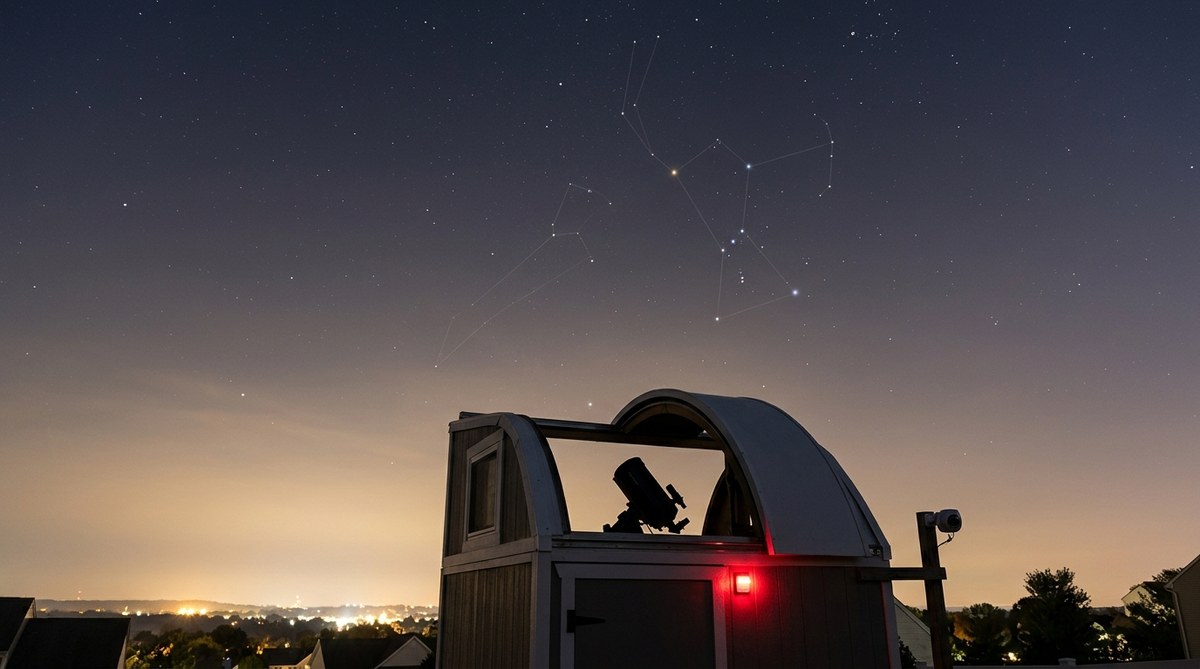
This is what the observer sees when the scope's laser is activated. The green laser's beam is projected upward through the observatory's open shutter. As you can see this makes it very easy to pinpoint exactly where the scope is pointing, especially when the expected object is not visible in the eyepiece. The beam can also be seen in the finder scope and the eyepiece. A separate hand held laser is used for teaching and or showing guests where an object is in the sky. (When this picture was taken the red interior lights were on and there was cloud cover).

The Starlight Express CCD camera, the Pictor control
box and Starlight Express USB interface box share one side of the pier. Most of
the cables are covered with Flex-tube to prevent them from getting tangled
during operations.

In this photo the ETX90 has been mounted on the computerized Meade "goto" LXD-55 German Equatorial Mount (GEM) with the Canon 10D Digital SLR camera attached at prime focus. This is the scope and configuration used for portability. This setup also supports the quick removal of the telescope and replacement with the camera and lens when wide field views are desired. The GEM mount is capable of remote computer control. (Note: Before use the camera strap is rolled up and secured so it does not get tangled during operation).

Stellarvue Binoviewer attached to the generic
Short Tube 80. I am impressed with the views from these binos, even
though their price is on the low end of the scale for binoviewers. When attached
on the Hydrogen-Alpha Scopemax-40 a
Siebert OCA corrector is used.


A Meade pier with a German Equatorial Mount (model 628).
The pier was manufactured in the 1980's. It suffered from corrosion (inside and
out) and the AC powered clock drive was not working. The unit has been repaired
and now works. It is shown here topped with an Orion 80mm refractor. It will
also be used as a mount for 4.5" Newtonian and the ETX90 OTA.


Here is the most recent addition to the observatory's
telescopes. It is a
Stellarvue SV102A. A apochromatic refractor
with a 102mm aperture and a 890mm focal length. In the first photo it is
shown mounted on the
Meade LXD-55 GEM. The second image shows it inside the
observatory mounted on the 10" LX200GPS using
Losmandy
hardware. Its configured for imaging with the
SBIG
ST-2000XM camera attached to the SV102A and the
DSI-Pro
attached to the LX200GPS as the autoguider.

Here are some of the 23 lbs of counterweights that were
needed to perfectly balance the piggy-backed SV102A telescope and SBIG camera
shown in the previous photo. The large counterweights total of17-1/2 lbs and are
attached to a modified Lomandy WS C11/M10 counterweight system. Two small black
1 lbs weights can be seen on each side of the larger weights. An EZ-Balance 3
lbs weight (not shown) is also attached to the visual back of the telescope. In
addition to that there are about 5 to 7 oz of weights in the fork arm where the
batteries used to be. This helps the RA balance of the scope.

The
Williams Optics Zenith Star 80 refractor is
seen here mounted on the LXD-650 German Equatorial Mount (GEM)

In this configuration both a Calcium K and Hydrogen-Alpha
PST can be seen piggy-backed on the LX200GPS. The 2 PSTs are bolted to a
standard 4" wide Losmandy dovetail plate adapter which is attached to the
dovetail plate on the OTA. This rail and dovetail adapter setup allows for very
quick reconfiguration of the scope. The total time to swap from the SV102a above
to the dual PST setup was less than 5 minutes and required no tools.

The grab-and-go solar platform. This setup features (from
left to right) a Coronado 40mm Hydrogen Alpha Personal Solar Telescope (PST), a
Williams Optics 80mm ZenithStar with a white light glass solar filter, a
finder scope with a solar film filter and a Coronado 40mm Calcium K PST.
The plate the scopes are attached to can be configured for mounting on
either a Meade LXD650 GEM or any 4" Losmandy type dovetail plate.

The Stellervue F50 finder scope has been modified by removing the original
diagonal. I never like the fact that the original diagonal didn't rotate. An
extension barrel was bonded to the removable back of the finder.
This will allow standard eyepieces and CCD cameras to be
connected to the F50. In the image above the
Mallincam
CCD video camera is
attached. This turns the F50 into a video finder or a widefield video image
which is great for remote use.

Here is a closer look at the Modified F50 Mallincam configuration. Because of the weight of the Mallincam the F50 OTA was moved forward in the mounting rings so the 3 adjustment screws on the rear ring hold the 2" barrel assembly and the front screw hold the OTA. The F50 can still be used with a standard 1.25" eyepiece as finder finder scope. With some eyepieces the Stellarvue helical focuser can also still be used. The modification allows other cameras such as the DSI Pro or the Canon 10D to be attached. In all cases focusing is achieved by adding or removing sections of 2" extension barrels and then adjusting the depth of the camera's nose piece (or eyepiece) in the barrel.

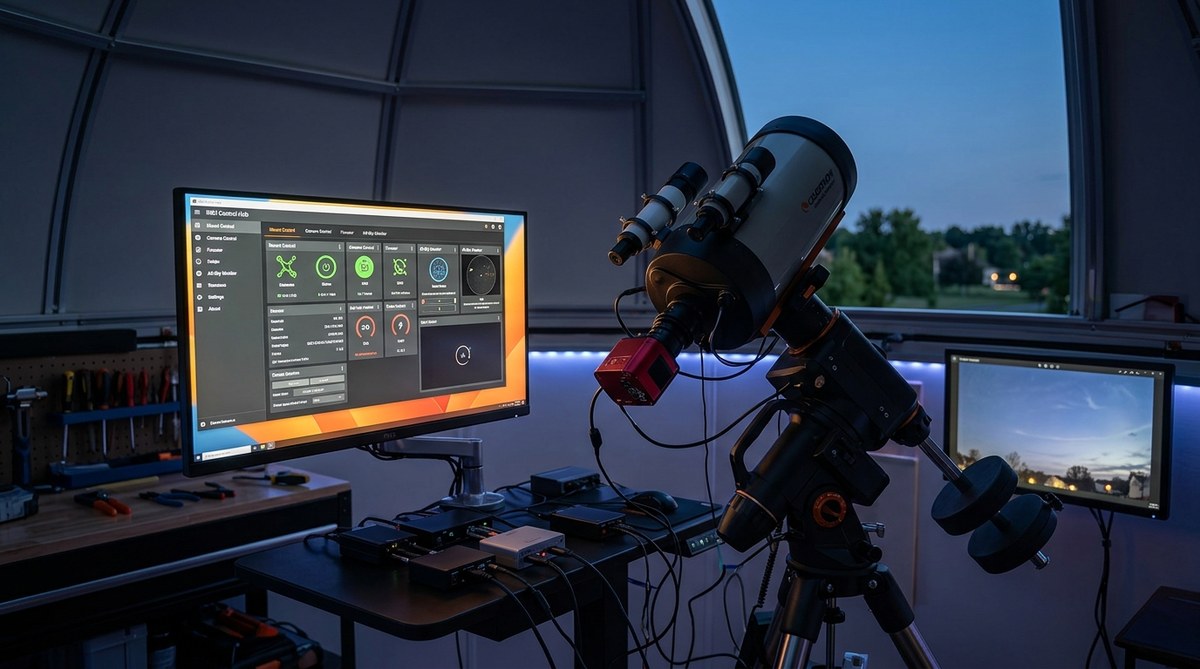
This is the output of the Mallincam which is connected
to the F50 finder scope. M42 (the Great orion nebula) can be seen in the center
of this image.
A 2nd video camera was added to the system. The
GStar-EX black & white camera was attached to
an inverted Losmandy
DCM2 camera mount which is attached to the
dovetail plate on top of the SV102a refractor. The camera is actually mounted
further forward than shown in the image above as the front ring mounting clamp
was visible in the camera flied of view. Although it doesn't look like it from
the picture above the lens clears the ring mount when the camera was moved
forward. The output from both the Mallincam and the GStar-Ex are fed to a
Slingbox A/V unit. The Mallincam is connected via S-video and the GStar-Ex via
an RCA jack. Either output and be video remotely from any network PC that
has the SlingPlayer client installed.

This is the display from the SlingPlayer remote client.
The actual picture on the PC is much clear than the screen shown in the example
above. The white tube see on the top is the OTA of Stellarvue 102A, the dark
tube on the bottom is the dew shield on the 10" SCT. The 3 stars in Orion's belt
can just been seen to the right of the SV102a. The gain on the camera and the
iris on lens have turned down so the camera can function from dusk to dawn
without washing out the image.


The camera is sensitive to infrared light. The 2 images
above capture the effect of an infrared beam when one of the observatory's
security cameras is triggered. The camera also must be covered during Solar
viewing to prevent damage.
The telescope configuration was recently changed. The 10" SCT is no longer in use. The new configuration consists of 6 refractors ranging in size from 40mm to 102mm. The setup has been nicknamed the "Array" and it can either be used for visual observing or imaging. The GStar-Ex camera that is used for monitoring the dome position is part of the Array. All of the scopes except for the larger 102mm mounted in the middle ride on dovetail adapter plates and are adjustable. This allows the Array to be collimated so all scopes point at the same target as the 102mm. (Click on the images above for larger versions.)
Shown above are the bottom (left) and top (right) views of the mount base for the Array. The base was assembled from ADM dovetail plates. The center plate was assembled upside-down so it could be attached to the Paramount ME's Versa-Plate. Unfortunately after assembly I found the difference in dimensions between the AMD and Losmandy Plates meant the ADM plates would not slide into the Versa-Plate. To work around this issue a Losmandy plate (not shown) was used in the center position. (Click on the images above for larger versions.)
Go to the JATObservatory Home page
Updated 05/18/2008 - Please report broken links jato@jatobservatory.org
*Notice: All images contained within these page are protected by copyrights and property of the JATObservatory. They may not be used or reproduced by any means without sole written permission from the owner.